Newspapers have a fascinating seat at the genealogical table. They are best described as source containers holding countless record types, ranging from formal obituaries to the cheerful local gossip of who attended whose 80th birthday party. They are broadly available and widely circulated compared to most genealogical sources, yet that democratic reach is offset by limitations in being ephemeral and non-durable. They represent the daily or weekly news and are quickly discarded, or even better were repurposed for kindling, packing material, or in some contexts even as toilet paper. Libraries and families preserved what they could, clipping items of interest or in some cases maintaining large sets of complete or partially complete issues.
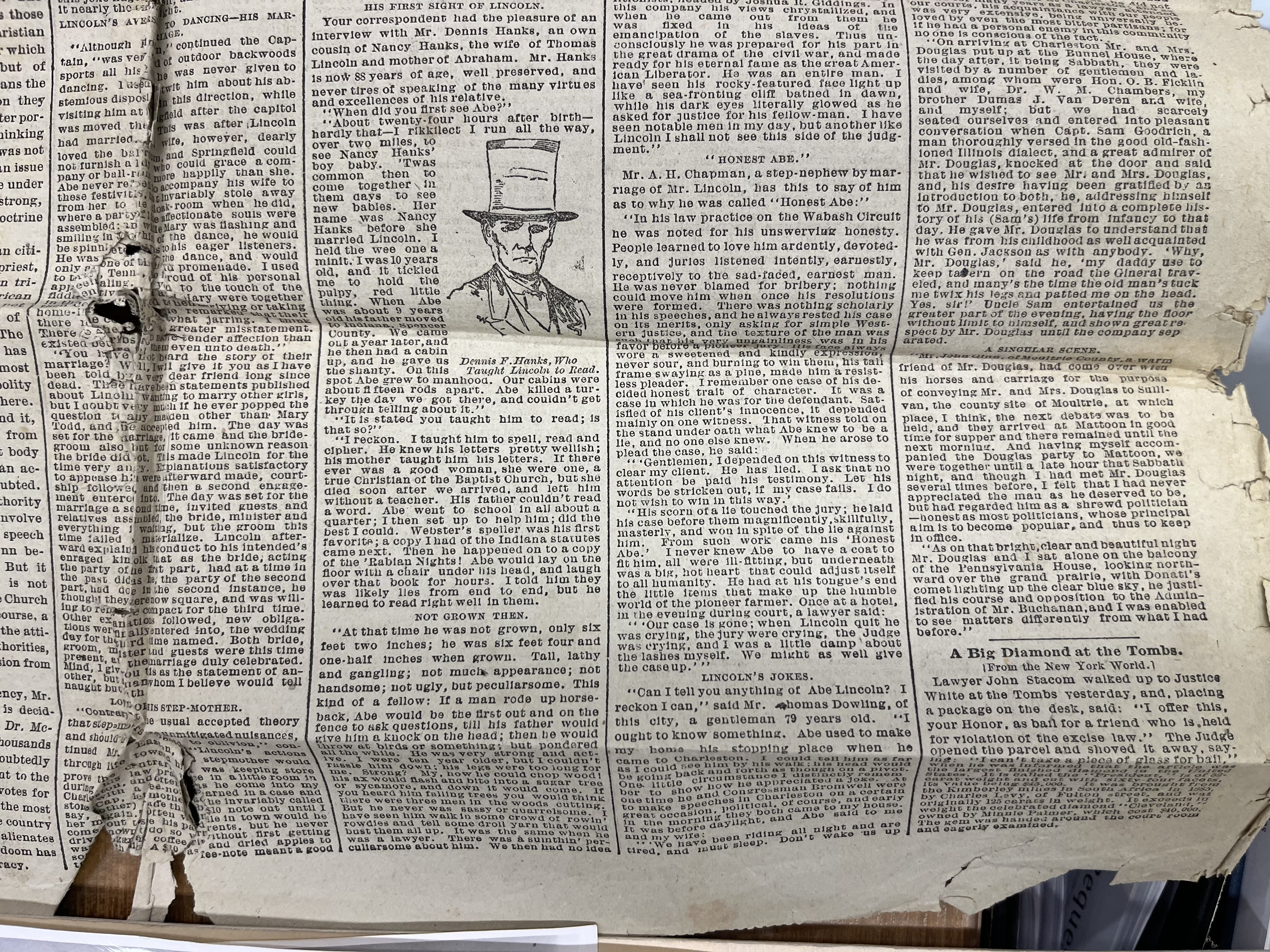
The fragility of the paper itself is a practical and an emotional reality for anyone who has worked with original copies. I recall sitting in a reading room at the Library of Congress, carefully unfolding a newspaper from a collection, asking the librarian to watch me and say stop if I was contributing further to existing damage. Fortunately, such encounters are increasingly rare. Most newspapers that survived into the modern era by way of libraries and genealogical societies with the foresight to microfilm during periods of the mid-twentieth century. The microfilm is imperfect — uneven coverage, some reels with damage, some years were simply never filmed — but it preserved what we have today, and much of that has since been digitized and made searchable.
What Newspapers Actually Contain
Newspapers are easy to underestimate until you start looking carefully. Most researchers think first of obituaries, which are genuinely valuable — but they are only one entry point into a much larger archive.
Vital records of every kind appear routinely: birth announcements, marriage notices, and death notices often ran in local papers even when the family had no intention of creating record elsewhere. In some periods and communities, a newspaper notice is the only surviving record of an event.
Obituaries deserve their own consideration. Their quality varies enormously by era and publication. A nineteenth-century small-town paper might run a two-line death notice with nothing more than a name and date. A mid-twentieth-century obituary from the same paper might include the full names of surviving children and grandchildren, the deceased’s birthplace, occupation, church membership, fraternal affiliations, and the names of predeceased relatives. That level of detail lays a nice trail of breadcrumbs that can lead to hypotheses and more evidence.
Social and community notices are chronically underused. The arrival and departure columns that appeared in many local papers — noting who was visiting relatives in the next county, who had returned from a business trip, who was ill, who had moved away — function as informal migration records. Seeing your ancestor’s name in an 1887 notice saying he had just returned from a visit to his brother in Ohio tells you something no census or vital record will.
Legal notices are among the most genealogically dense content newspapers carry. Probate notices, land sale announcements, sheriff’s sales, name changes, and dissolution of business partnerships were commonly required by law to run in local papers for a specified period. These were often legal compliance documents in a newspaper format, and they contained information such as relationships, property, and financial circumstances.
Court and criminal reporting varied from brief mentions to detailed accounts. Arrest notices, trial coverage, and sentencing reports named not just the accused but often witnesses, victims, attorneys, and jurors — a rich FAN club (family, associates, and neighbors) snapshot in a single article.
Business and professional notices tell you what your ancestor did for a living and who they did it with. This may add insight into their FAN club as well as something to collaborate with employment information from Census and other sources.

Letters to the editor, local correspondence columns, and community gossip reports painted a picture of daily life that can give context and color to the person that your set of records represent. They place your ancestor in a community, establish their reputation and connections, and occasionally reveal details that survive nowhere else.
The Informant Problem
Every record type has an informant and newspapers are no exception. Understanding who provided the information in a newspaper item, and whether they were in a position to know it, is as important for newspapers as it is for any other source.
Obituaries are a useful case study. The information in an obituary typically came from the family, which means it is secondary information at best for events that occurred before living memory. A 1910 obituary stating that the deceased was born in County Cork in 1841 reflects what the family believed or chose to report — it is not a primary record of birth. It may be accurate, it may be approximate, and it may occasionally be wrong in ways the family didn’t recognize. The more distant the event from the informant’s firsthand knowledge, the more cautiously the detail should be treated. Nevertheless, this obituary can be a starting point to define viable research leads related to the birth.
The same logic applies to vital notices. A birth announcement written by a proud father may be primary information about the fact of the birth but may be less reliable on details like the exact birth date or even the spelling of the child’s name. A death notice submitted by a grieving spouse may contain errors that no one caught before publication.
This does not make newspaper information completely unreliable — it makes it evidence to be evaluated. The question is always: who knew this, how did they know it, and how far removed were they from the event? To paraphrase James Tanner, the mother was certainly there when the baby was born.
The OCR Reality
The digitization of historical newspapers has been genuinely transformative for genealogical research. Collections like Chronicling America, Newspapers.com, and GenealogyBank have made millions of pages searchable that previously required physical presence at a library or a microfilm reader. The convenience is enormous. So is the risk of misplaced confidence.
Optical character recognition — the technology that converts scanned newspaper images into searchable text — performs imperfectly on aged, faded, and damaged newspaper pages. The results can be surprisingly poor. Ink bleed-through from the reverse side of a page corrupts characters. Faded type causes letters to disappear or merge. Historical typefaces, particularly the German Fraktur script used in German-language American papers well into the twentieth century, produce distinctive and predictable OCR errors. The long s — a letterform that looks to modern eyes like an f and appears in English-language papers through the early nineteenth century — causes systematic misreadings.
The practical consequence is that a name search that returns no results does not mean the name isn’t there. Your ancestor may appear on every page of every issue of the local paper for thirty years, rendered in OCR text as something your search never would have tried. Searching for name variants — including OCR-error variants specifically, not just spelling variants — is not optional; it is part of a complete search strategy.
The image itself is always the primary source. When you find a result through full-text search, look at the page image. When a search returns nothing, consider whether browsing the images directly for the relevant period is worthwhile, especially for narrow date ranges where you have reason to expect coverage.
Our free VariantChronicles tool automates exactly this: it searches Chronicling America across OCR-error and spelling variants and groups the results by the variant that produced them.
Coverage, Gaps, and Selection Bias
Working effectively with newspapers requires honest accounting of what they do and do not cover.
Geographic scope matters more than it might seem. A county seat paper may have covered the county seat well and the surrounding townships inconsistently. A city daily covered the prominent, the criminal, and the commercially newsworthy activities. A rural weekly covered the community it served, which often meant deep coverage of ordinary residents and topics not touched on by larger city newspapers. Matching the right paper to your research question is not always obvious, and many researchers never consider whether a smaller, more local paper might have better coverage than the regional one that was easier to find. Smaller, limited run papers that may not be fully digitized or perhaps not accessible on your digital platform of choice may yield information that exist nowhere else.
It’s important to note the bias in coverage. Newspapers (and media in general) can tend to portray the prominent more thoroughly than the obscure, property owners more than renters, white residents more than Black or Indigenous residents, men more than women except in circumscribed social roles. This is not a reason to avoid newspaper research — it is a reason to understand what you likely versus unlikely to find, and to seek out papers specifically oriented toward communities that mainstream papers may have ignored. The African American press, German-language papers, Yiddish dailies, labor publications, and denominational newspapers served audiences that the mainstream press rendered largely invisible, and they can be extraordinary sources for researchers working those communities.
Publication gaps are a constant companion. Even well-preserved newspaper runs have missing issues, damaged pages, and years that were never microfilmed. Before concluding that a search was exhaustive, it is worth checking whether the issues you needed were available in searchable form, or whether they exist only as damaged originals in a single repository, or not at all.
Reading the Context, Not Just the Name
One of the most underused aspects of newspaper research is the information surrounding the item you found. Someone who locates an ancestor’s name in an 1890 newspaper, copies the statement that directly mentions the ancestor, and then just moves on leaves a lot of potential value on the table.
The names adjacent to your ancestor are often as important as the record itself. Witnesses to a marriage, co-signers on a business notice, neighbors mentioned in the same social column — these are the building blocks of the FAN club analysis that frequently provides the breakthrough a direct-line search cannot. The person who accompanied your ancestor to a county fair, whose name appears in passing in a community column, may be a sibling, a cousin, or a business partner whose relationship is documented nowhere else. And as mentioned earlier, this information helps describe the broader context of the community your ancestor was part of in a specific moment.
A Note on Citation
A complete newspaper citation includes the paper’s full title, the publication city, the publication date, the page and column number, and the repository or database where you accessed it. If you accessed it through a digital database, the URL and access date belong in the citation as well, because digital access points change and the URL documents the specific path you took.
If you photographed or transcribed a physical original or microfilm, note that. If you are working from a digital image, note whether the image quality was sufficient to read the text clearly — a note that a particular column was partially illegible is part of the honest record of what you found and what it means.
The instinct to write down just the name and date and move on is understandable, but a citation that can’t be reproduced by another researcher is only half a citation.
Final Thoughts
Newspapers are not a secondary source in the dismissive sense that term is sometimes used. They are a distinct category of evidence — rich, contextually dense, imperfectly preserved, and arguably underexploited by some who use them for obituaries and nothing more. The researcher who learns to read a historical newspaper as a complete document, rather than a database to query for a specific name, will tend to find more records related to their ancestor and their FAN club. They will also gain broader literacy of a specific time and place, which can pay dividends in ways that are hard to predict but easy to underestimate.
About the Author
Nathan is an avocational genealogist and the founder of Evidence Toolbox. His research practice is grounded in the Genealogical Proof Standard, with primary-source work conducted at major repositories including the Library of Congress. He builds the tools on this site to solve problems encountered in his own research, and field-tests each one against real family lines before release. You can reach him at contact@evidencetoolbox.com.